
Sierra Reflections
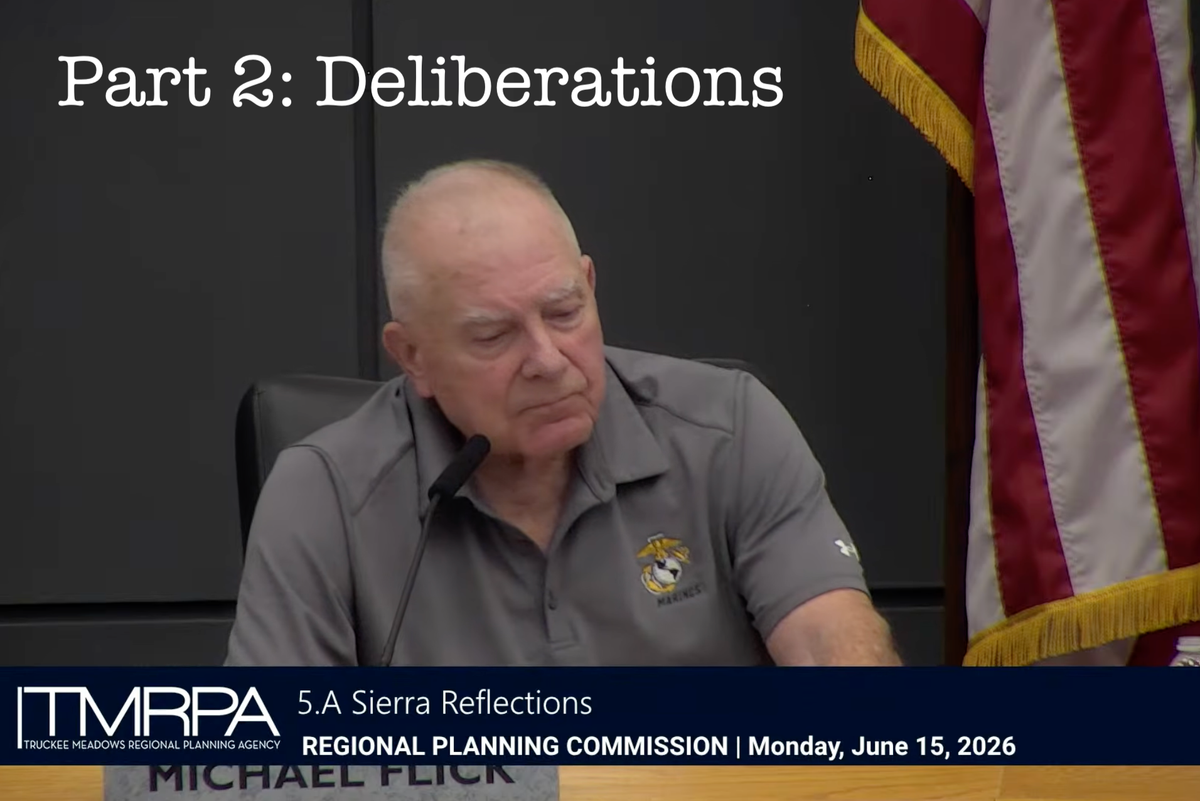
The following is an AI prepared summary of the deliberations of the TMRPA Board members at the end of the June 15, 2026 meeting. This was after public comments, staff report, developer presentation and community attorney presentation.
Chapter Two of our review of the proceedings is the deliberations. The video of the entire 6+ hour hearing is here on YouTube. The Board approved the developer's Application. The deliberations start at time 4:46.

- Unidentified public speaker: Raised strong concerns about mercury contamination, groundwater leaching, wildfire risk (cited Laguna Beach experience), traffic impacts, school safety; criticized personal attacks and urged respectful debate.
- Chair/Moderator: Closed public comment and opened board questions.
- Commissioner (questioner) to Lauren Chilson/Mr. Chilson: Asked whether disaster evacuation is a standard in road capacity studies.
- Lauren Chilson / Mr. Chilson (traffic consultant): Stated evacuation modeling is not a formal county/NDOT standard though considered; project adds traffic but provides an emergency connection through St. James Village, improving overall connectivity.
- Amy Misnikowski (hydraulics/engineer): Explained hydraulic modeling covers 5- and 100-year events, is limited to the project area tied into upstream/downstream ends, shows no increase in peak runoff or inundation downstream and slight peak-flow reduction with on-site detention; model does not extend to show flow across Pony Lane.
- Ken Crater (applicant/engineer spokesperson): Clarified roundabout location will be south of Pagni Lane, Pagni Lane section to be abandoned; said 300-ft sensitive stream zone remains, excavations and local reuse of mercury-impacted soils planned to minimize transport, fill won't necessarily be 8 ft above existing channel, and detention basins designed not to increase downstream flows.
- Amy Misnikowski (follow-up): Clarified FEMA remapping uses an “effective” model; the more confined AE mapping in design is based on existing conditions, not proposed grading; reiterated project-area model does not show flow across Pagni Lane and shows no increase at downstream locations.
- Joe McInley / Ben Clink (environmental/UEES): Said IPaC screening identified Carson Valley wandering skipper as potential but no critical habitat; explained skipper requires salt-grass flats (site is irrigated/grazed, not natural salt-flat); mule deer sign present but no Nevada regulatory trigger for mule deer habitat on private land; described delineation findings that many irrigated channels are not relatively permanent and that proposed setbacks avoid ordinary high-water marks, so no Section 404 Clean Water Act permit required for fill.
- Melissa Ruth (landscape architect): Said final landscape design will address Wildland-Urban Interface (setbacks, fuel management, plant choices) and avoid creating fire ladders.
- Ken Crater (added): Said project must meet WUI design standards, fire department will review landscaping, plans include a 4x4-accessible loop trail for fire apparatus, public street hydrants and HOA responsibilities (maintenance, potential grazing/goats) will aid fire mitigation.
- Brian Wadsworth (former water-quality staff / tribal monitoring): Said past monitoring around Veterans Parkway did not include mercury; his office had concerns about encapsulation methods and potential flood release of mercury downstream to Pyramid Lake.
- Dr. Kevin Burl (butterfly expert): Stated no known Carson Valley wandering skipper populations on the site or immediately adjacent; populations exist miles away; noted habitat designations can aid species recovery/recolonization and that question of potential habitat value is relevant.
- Trevor Lloyd / Chris Bronzik / County planner: Confirmed current map is tentative/sketch; there are over 200 conditions of approval that must be met before final map.
- Ken Crater (sewer discussion): Explained St. James Village homes have dry sewer laterals and have paid connection fees; developer must build Reach 4 connection and contribute prorata share to Reach 3; building permits require public sewer connection before issuance.
- Trevor Lloyd (timeline): Noted statutory four-year window for obtaining all required permits after tentative map approval.
- Dr. Jeremy Smith (TMRPA): Described regional land designations: TMSA (area expected to have municipal services in 20 years) vs rural; Sierra Reflections lies within the TMSA (tier 3) and thus is considered part of growth area despite rural characteristics.
- Joe McKinley (mercury standards): Clarified site contains mercury-impacted soils (not elemental mercury); remediation standards used historically (e.g., Comstock) and applied here; stated state remediation and county requirements are stringent and EPA is unlikely to impose stricter standards; asserted developer is bound to implement county-mandated mitigations, covenants, and bonds.
- Ken Crater (buffer/access): Reiterated 300-ft (150 ft each side) sensitive stream buffer with no pedestrian access, split-rail fencing and signage; trails will be in upland areas.
- Wes Rubio (Northern Nevada Public Health): Explained remediation approach: sample to determine contamination depth, remove or sequester contaminated soil on site as needed, then place clean fill to a protective depth (up to 8 ft where required); developers must demonstrate soils in public rights-of-way meet limits (residential 7.1 mg/kg, commercial/ROW 30 mg/kg); sampling/confirmatory testing occurs before final grading/build-out and at permit-trigger points; strict handling, tarping and tracking procedures during earthwork.
- Ken Crater (buyer disclosure): Stated developer will proactively disclose mercury presence and mitigation to buyers; documentation will carry through chain of title; CC&Rs will include excavation depth limits per county condition.
- Dave Grove: Noted CC&Rs include excavation depth limitation related to mercury as required by county conditions.
- Traffic/Planning speakers (Lauren Chilson, Ken, civil engineer): Clarified estimated daily trips: project ~8,900 daily trips (regional significance threshold ~6,250); historical ADT data presented (peak pre-freeway ~37,000, fell after freeway, projected 20-year growth ~16–17,000 ADT); roundabouts chosen per NDOT ICE, sized for trucks, located at flattest roadway points, and provide safety/capacity benefits and evacuation resilience.
- Ken Crater (emergency access / gates): Explained the St. James undercrossing will be improved as first-phase St. James Parkway, gated for emergency use, equipped with Knox box; fire marshal/sheriff can open gate quickly in emergencies.
- Civil engineer / roundabout discussion: Described modern roundabout design accommodates trucks/buses (truck aprons, lower center islands), reduces crashes and operates without signals during power outages.
- Bill Naylor / Kathleen Meyer / project engineer (grading/retaining wall debate): Bill Naylor asserted grading plan shows multiple 6-ft slabs and a long retaining wall (accused applicant of dumping contaminated soil into park); Kathleen Meyer and the engineer countered Park 1 shows a 12-ft-wide maintenance/access road and some retaining walls elsewhere, but no 12-ft-tall retaining wall for Park 1; engineering representative said grading exists but disputed claim of a 12-ft tall retaining wall. (Editors note: Retaining Wall is shown on developers map).
- Jessica Prreny (legal counsel): Reviewed NRS/regional-plan statutes: broad definition exists for public facilities (could include police/fire), but regional plan historically has not incorporated police/fire as required public facilities; local jurisdictions (per NRS 278.349) must consider fire protection and access in tentative-map approvals—local responsibility; the regional board’s review is limited to conformance with the adopted regional plan, not policing local project compliance with local master-plan details; noted mechanisms exist (conformance findings, legislative change, or courts) if relief is sought.
- Online participant(s): Indicated no questions but reserved comment for later.
- Shelly Reid (board member): Thanked public and experts, acknowledged concerns were well presented, noted many additional steps remain before project execution and encouraged continued public participation.
- Unidentified commenter (follow-up on St. James Parkway): Warned that St. James Parkway is steep, residential, has multiple roundabouts and speed bumps and does not provide high-capacity egress—argued this context was omitted earlier.
- Motion & Vote (board action): Board member moved to find Sierra Reflections project of regional significance and in conformance with the 2024 Truckee Meadows Regional Plan; roll-call vote passed with some “no” votes citing concerns about inclusion of fire/police in public-facilities consideration and desire to revisit regional plan language.
- Chair / Closing: Announced motion passed, moved on to requests for future agenda items and public comment.
Members Discussion