
Sierra Reflections
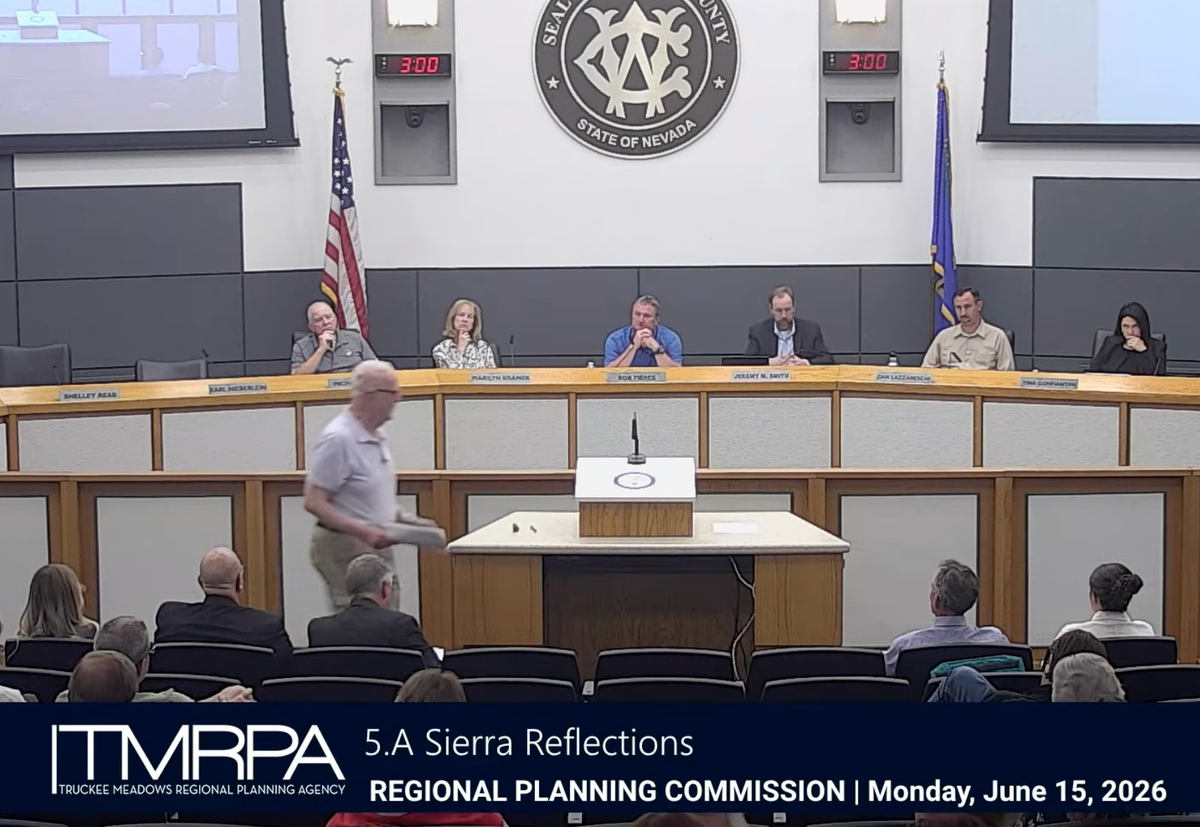
Review and analysis of the Regional Planning Board approval of the Sierra Reflections development from June 15, 2026.
Method
There's a lot to discuss about the disappointing actions and vote from our Regional Planning Commission's review and approval of the urban development in rural South Washoe County so I've decided to spread it out over about three posts.
In this first article I'll post the comments by Michaela Jones, attorney with the firm Snell and Willmer who represents the Pleasant Valley Landowner's Association. Her testimony gives the legal perspective in the opposition to the project and the TMRPA's questionable procedures and vote so that is a good place to start.
Ms Jones gave her comments at the end of the public comments which we will review in a later post. We will also detail in a later post the deliberations the Planning Commission took at the end of the meeting and their vote to approve.
Summary
Ms Jones statements in her four points how the procedures and actions of the County Commissioners and Regional Planning Commission are in conflict to their own and Nevada's policies. She then goes on to cite specific cases that are in conflict with those attitudes, policies and actions. Finally, she explains that it is not the governing bodies job to efficiently "rubber stamp" and promote development but to analyze the actual impacts and take into considered account citizen testimony. This is a good read to more fully understand the role, responsibilities and obligations of our community planning system.
The legal fight will continue and to contribute to the cause, go to this link.
(Note: This Youtube created transcript is from the Washoe County Youtube video of the meeting and was cleaned up by your editor. Errors may still exist.)
Attorney Michaela Jones Comments
Timestamp: 4:36:29
Good evening, commissioners, Dr. Smith and Miss Purenty. My name is Michaela Jones, and I am here tonight with my partner, Bill Peterson, and we are attorneys with Snell and Willmer.
First, thank you for allowing me to address you tonight on behalf of the Pleasant Steamboat Valley Landowners Association. In addition to a dozen residents and property owners immediately adjacent to the project site, we ask the commission to find the Sierra Reflections project not in conformance with the 2024 Truckee Meadows Regional Plan.
Whether Sierra Reflections conforms with the regional plan is your determination alone. It is not a rubber stamp. The fact that the board of county commissioners voted 3/2 to approve or that a prior version was found in conformance in 2006 under a different regional plan does not relieve this commission of its independent statutory obligation.
Much has been said tonight about what you cannot consider. But what is the point of being powered by statute and a reasonable plan to consider elements of a project if you cannot make a decision based on them?
Let me be clear on what we've seen tonight. Repackaged presentations attempting to address defects and deficiencies pointed out by public opposition at the May 28th meeting trotting out engineers, archaeologists, hydrologists, and a school district head desperate for students.
But the whole presentation is best summed up by the property owner's agents own statement that this is not rural. The response and laughter from the audience was not rude, but a genuine reaction to such an absurd comment.
It cannot reasonably be disputed that the project will have a major negative impact on the area designated in the plan as last (?) for development.
Regional planning staff has provided you with the proposed motion to approve the project. That motion is a single sentence incorporating by reference the findings contained in the staff report.
The staff report also advises that if you determine the project is not in conformance with the regional plan, you should identify the portions of the plan with which it does not conform and explain why.
Respectfully, that approach is inconsistent with Washoe County's burden.
Approval requires each commissioner to affirmatively determine that the project promotes and does not conflict with the regional plan. Approval requires you, not staff, not the property owner, not Washoe County, to make each of the findings necessary under RC9Critically, denial does not require a finding that every aspect of the project conflicts with the regional plan. If you cannot make even one of the findings necessary for approval, then the project is not in conformance and it must be denied.
With that in mind, I have just handed out to you a proposed motion for your consideration. It is offered respectively as a practical tool grounded in the testimony, evidence, and presentations you have heard tonight, identifying several independent reasons why the required findings cannot be made.
Any one of those findings can and respectively should be fatal to the conformance analysis.
I want to take a few minutes to address one point in particular, fire protection. It would be error for this commission to fail to address fire protection under public facilities in the services factor. Dr. Smith has represented that this body cannot consider fire services because it is not separately listed in table 3.2 of the regional plan. But table 3.2 of the two does not define the full scope of public facility services for purposes of RC9 factor 3. Three independent sources do.
First, the statute NRS 278.0157 defines infrastructure and public facilities to mean “facilities and the structure or network used for delivery of goods, services, and public safeties and safety”. and states that the term includes without limitation quote fire, police, and flood protection. That definition applies throughout chapter 278 including NRS 278.0278 and including NRS 278.0274, which mandates the contents of the regional plan's public facilities section.
Second, the regional plan itself. The plan's own glossary term defines public facilities as “a use conducted by or a facility or structure owned or managed by a publicly funded entity that provides a governmental function, activity, or service for public benefit.”
Fire protection is a governmental service provided for public benefit and that squarely fits within the plan's own definition.
Next, the master plan and the internal review memo. Envision Washoe 2040 identifies limited fire protection as a development constraint in the south valleys and TMRPA's own IRM prepared for this project shows that over 680 acres of this site nearly 90% falls within the high fire risk area.
So when the regional plan requires you to consider whether public facilities and services are adequate to support this development, fire protection must
be part of that analysis. It is a defined term. That testimony on this front speaks for itself. And for this reason and all other points you heard tonight, the project is not in conformance with the regional plan.
There is a final point I would like to make tonight. That is that government process is not meant to be efficient. It's supposed to be thoughtful and it's supposed to be deliberative. And only then can it be effective. The best any of us can hope for is that those entrusted with making decisions that profoundly affect our lives, our livelihoods, and our communities will give those decisions the time, fairness, and consideration they deserve. Not simply to hear the public, but to listen. And not simply to pay lip service to the process, but to honor it.
And I want to assure you that when you carefully consider the testimony you have heard tonight and allow it to inform your decision, you are doing exactly what Nevada courts have repeatedly upheld. The Nevada Supreme Court has long held that public agencies may properly rely on public testimony and citizen observations when making land decisions. In case after case, the court has upheld agency decisions based on testimony regarding fire risk impacts to wells and water resources, wildlife and livestock, visual impacts, and traffic.
To point you to a few of them, city of Las Vegas v. Laughlin 111 Nevada 557 from 1995. There, the Nevada Supreme Court held that substantial and specifically objections expressed by the public, including those over increased traffic where children walk to school, establish a valid basis for denial of the application. In Stratosphere Gaming Corporation versus the city of Las Vegas, that's 120 Nevada 253. From 2004, the court concluded that individuals testifying and submitting written protests about the lack of compatibility of the location, increased traffic, and resulting safety concerns support the denial of the applicant's application.
And then next, Redbook Valley, Red Rock Valley Ranch LLC versus Washoe County, that's 127 Nevada 451 from 2011. There the Nevada Supreme Court held that the 34 members of the public testifying about increased fire risk, impacts to existing wells, impacts to wildlife and livestock, visual impacts, noise pollution, and air quality issues constituted substantial evidence to support the Washoe County's denial of the application.
This is what is in the record before you and what you have heard tonight. Substantial, specific, organized testimony and evidence from people who know this community because it is their home and because they live there.
As tired as everyone may be and as much as you have been urged to rubber stamp what has come before you, I respectfully urge you not to do that. If this regional conformance process is to mean anything, it must have teeth. Or else why are we here? It is both your privilege and your obligation to consider what has been presented to you, the testimony, the evidence, and the specific reasons why the required findings cannot be made.
And as the last person speaking to you after a long public comment session, I would simply like to make this point that the long night is the point.
The time, the testimony, and the public participation are not inconveniences to the process. They are the process. The fact that the record is lengthly does not make it less important. It makes it more important. And the fact that the public showed up informed, engaged, and prepared does not make this process inefficient. It makes it legitimate.
And this process what produces for the most part sound decisions is what gives meaning to the Regional Plan and to your vote tonight and is what ensures the decisions affecting our communities are made with the care and deliberation they deserve. For these reasons, I respectfully urge you to make the right decision tonight. Find Sierra Reflections not in conformance with the 2024 Truckee Meadows Regional Plan. Thank you.
Members Discussion